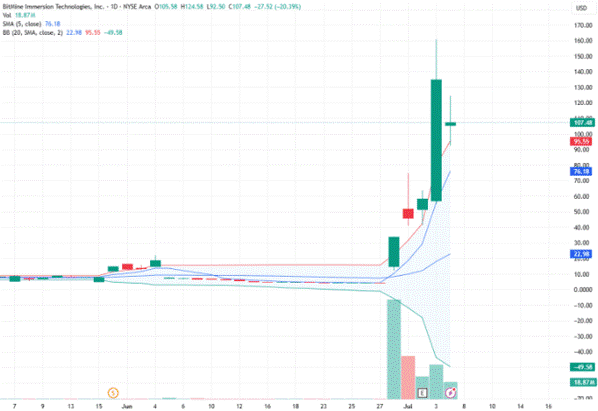


"What if a stock jumped 30x in just one week?"
Sounds insane—but it actually happened.
Meet BMNR.

In June 2025, BMNR (Bitmine Immersion Technologies)—a thinly traded stock on the AMEX—skyrocketed over 2,900% in just five trading days. Crypto buzz and a tightly held float fueled the surge, turning an obscure nanocap into a meme stock phenomenon overnight. Retail forums called it the “rebirth of meme mania.”
Explosive moves like this are rare, but in the world of micro- and nano-caps, they’re far from impossible.
But here’s the flip side—some stocks get cut in half in a single day.

Not every story ends with fireworks.
In 2022, SBFM (Sunshine Biopharma) plunged over 60% in a single day after a string of bad news—a failed clinical trial, a dilutive offering, and a reverse stock split.
Investors saw their portfolios cut in half overnight.
This is the double-edged nature of the small-cap world: jaw-dropping upside paired with equally brutal downside.
That’s why chasing returns alone—especially in microcaps—is a dangerous game without serious risk controls.
Not All Small-Caps Are Created Equal

Small-cap stocks are typically classified by market capitalization. But beyond the numbers, their market behavior is a world of its own.
Think of it this way:
- Large caps are like massive continents—Asia, the Americas—well-mapped and familiar.
- Mid caps resemble stable nations attached to those continents.
- Small caps? They’re the remote islands—out there, under the radar, and full of surprises.
On these islands, a few patterns repeat:
1. Information Voids
Large caps have analysts, earnings calls, and press releases in real-time. Small caps? Often radio silence.
You're not just looking for treasure—you might accidentally step on a landmine. The lack of information makes due diligence both harder and more important.
2. Liquidity Whiplash
Most days, trading is dead quiet. Then suddenly, one spark—a press release, a rumor—and the volume explodes.
Like a small boat caught in a rogue wave, prices can swing violently without warning.
3. Extreme Payoffs
In this world, $100,000 of inflow can move a stock 2x or more.
That doesn’t mean high risk always leads to high return—but the price elasticity creates real potential for outsized gains.
In short, small-caps live at the intersection of undervaluation, obscurity, and market inefficiency.
That’s why you’ll sometimes find 10x or even 100x returns—and just as often, stocks that collapse into oblivion.
The Small-Cap Premium: Theory Meets Market Reality

For decades, researchers have documented the “small-cap premium”—the idea that companies with smaller market capitalizations tend to outperform their larger peers over time.
In 1993, Fama and French formalized this with their influential 3-Factor Model, introducing the SMB (Small Minus Big) factor. This wasn’t just a statistical quirk; it was a structural insight: small caps tend to deliver higher returns, not just because of market timing, but due to their very nature.
Later studies, like Hou, Xue, and Zhang (2015), explained that these excess returns reflect a risk premium. Investors demand higher compensation for buying stocks with information gaps and low liquidity—common traits of small-cap companies. These inefficiencies often lead to mispricings, which attentive investors can exploit.
Bottom line: small-cap investing means embracing higher uncertainty in exchange for potential long-term rewards.

A chart comparing microcap ETF performance (purple) with the S&P 500 ETF (red) from 2009 to 2010 paints a clear picture: while the S&P steadily recovered post-crisis, microcaps surged at a steeper rate.
This wasn’t random—it was a classic trickle-down rotation. As institutional capital regained confidence, it flowed from blue chips into smaller, overlooked names. The most beaten-down corners of the market became the biggest beneficiaries.
A similar pattern played out after the 2020 COVID-19 crash. Markets plunged amid unprecedented lockdowns and demand shocks, but then came a flood of liquidity and near-zero interest rates.
With retail investors entering the market in droves, ultra-small stocks became prime targets for high-risk, high-reward bets. Microcaps soared—fueled by speculative fervor and the sheer force of revaluation.
These episodes show a consistent truth: when recoveries begin, microcaps often lead the charge. Their combination of suppressed valuations and price sensitivity makes them natural rebound plays.
The chart from mid-2020 to 2021 tells the story clearly:
While large caps recovered steadily, microcap indices surged nearly +120% in just over a year.
Fueled by a wave of retail trading, speculative themes, tech-driven small caps, and short squeezes, microcaps became the epicenter of the rally.
This wasn’t just about hype—it was a function of how microcaps respond to market cycles.
In recovery phases, they often deliver outsized gains thanks to their elastic pricing, low liquidity, and neglected valuations.
It’s not just about being small—it’s about being the first to move when sentiment shifts.
For investors, that makes small-cap strategies not just viable, but often vital.
The Small-Cap Premium Isn’t a Free Ride
But let’s be clear—not every small cap is a winner.
Especially in micro- and nano-cap territory, blind faith is dangerous.
A 2013 study by Rodríguez‑Cicia showed that microcap funds carried much higher risk, particularly in terms of volatility and idiosyncratic shocks.
Yet many of these funds failed to generate statistically significant excess returns.
In short, risk didn’t always translate into reward.
This reminds us: the “small-cap premium” isn’t guaranteed.
In markets riddled with thin liquidity, poor information flow, and extreme volatility, jumping in without a framework can be fatal.
But from a different angle, this also means:
If you can control risk, there’s meaningful alpha to extract.
Hedge funds and quant managers often apply filters like:
- Debt ratios and interest coverage to weed out weak balance sheets
- Real-time monitoring of red flags (reverse splits, dilutive offerings, failed trials)
- Minimum daily trading volume thresholds
- Institutional accumulation signals (e.g. going from 0% to >5% ownership)
Ready to Explore the Frontier?
The world of micro- and nano-caps is high-risk, high-reward—and highly inefficient.
Price dislocations, information gaps, and neglect aren’t just obstacles—they’re rare opportunities for the prepared.
One of the most fascinating dynamics in this space?
Stocks that once spiked dramatically often come back to life.
Boom → bust → revival—it’s a pattern we’ve seen again and again in small-cap land.
So here’s the question:
Can past runners run again?
And more importantly—how do you spot them before they take off?
In our next episode, we’ll dive into the “revival pattern”—tracking former high-flyers from the early 2020s that soared, crashed, and made surprising comebacks.
Stay tuned.
[Compliance Note]
All posts by Sellsmart are for informational purposes only. Final investment decisions should be made with careful judgment and at the investor’s own risk.
The content of this post may be inaccurate, and any profits or losses resulting from trades are solely the responsibility of the investor.
Core16 may hold positions in the stocks mentioned in this post and may buy or sell them at any time.